Calaverandia 2026 at a Glance
Opening: October 23, 2026
Where: Parque Ávila Camacho, Guadalajara, Jalisco, Mexico
Best for: Couples, families, friends, photographers and international travelers
Recommended time: Approximately 4 hours
Best arrival: At opening, especially if you want sunset and nighttime photographs
Don’t miss: ALMA, Gran Altar Canoil, Omitlán and Inframundo
Bring: Comfortable shoes, a light jacket and a fully charged phone
If you are visiting Guadalajara around Día de Muertos, put one evening aside.
You may arrive expecting a theme park.
You may leave understanding something much more interesting about Mexico.
Day of the Dead in Guadalajara 2026: Why Calaverandia Should Be on Your Mexico Itinerary
If you happen to be in Guadalajara in late October, you may notice something changing as the sun goes down.
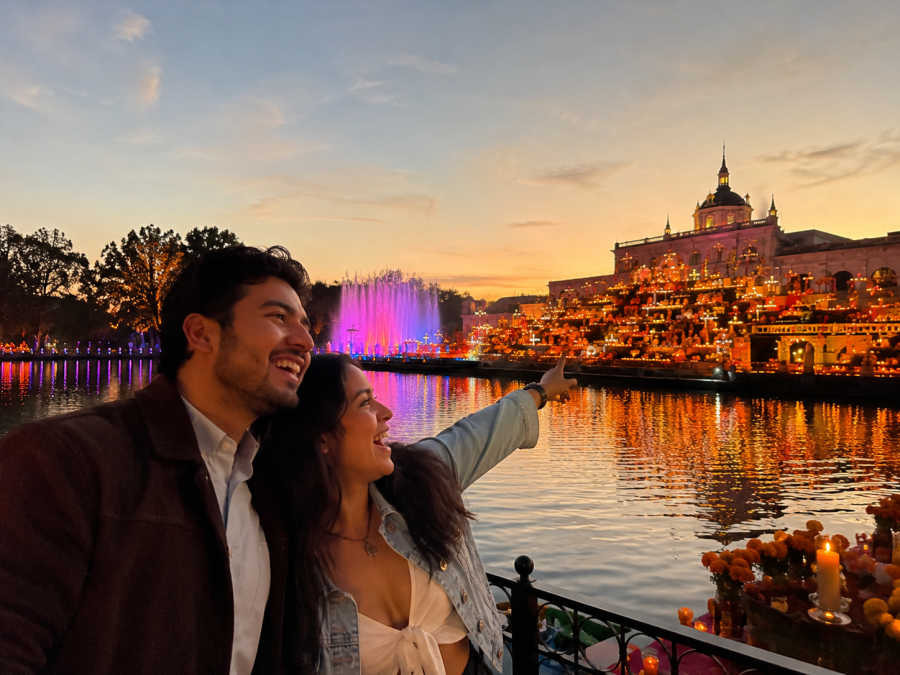
Orange marigolds begin appearing everywhere. Skeletons become elegant rather than frightening. Candles flicker beside photographs. Catrinas smile from shop windows. Bakeries fill with pan de muerto. Families begin preparing altars, and the city slowly enters one of the most fascinating seasons to experience Mexico.
Then, after sunset, there is Calaverandia.
Beginning October 23, 2026, Guadalajara once again welcomes one of its most unusual seasonal attractions: an immersive theme park dedicated entirely to Mexico’s Día de Muertos, or Day of the Dead.
Held at Parque Ávila Camacho, Calaverandia combines Mexican tradition with theatrical entertainment, monumental installations, music, food, interactive attractions, spectacular lighting and large-scale multimedia shows.
For travelers visiting Guadalajara from the United States, Canada, the United Kingdom, Australia or elsewhere, it can be one of the most accessible — and certainly one of the most visually spectacular — introductions to the imagery and traditions surrounding Día de Muertos.
But there is something you should understand before going.
This is not Halloween.
And despite the thousands of skulls you are about to see, the purpose is not really to scare you.
Calaverandia is about Mexico’s extraordinary ability to turn remembrance into color.
Why Guadalajara Is a Great Place to Experience Día de Muertos
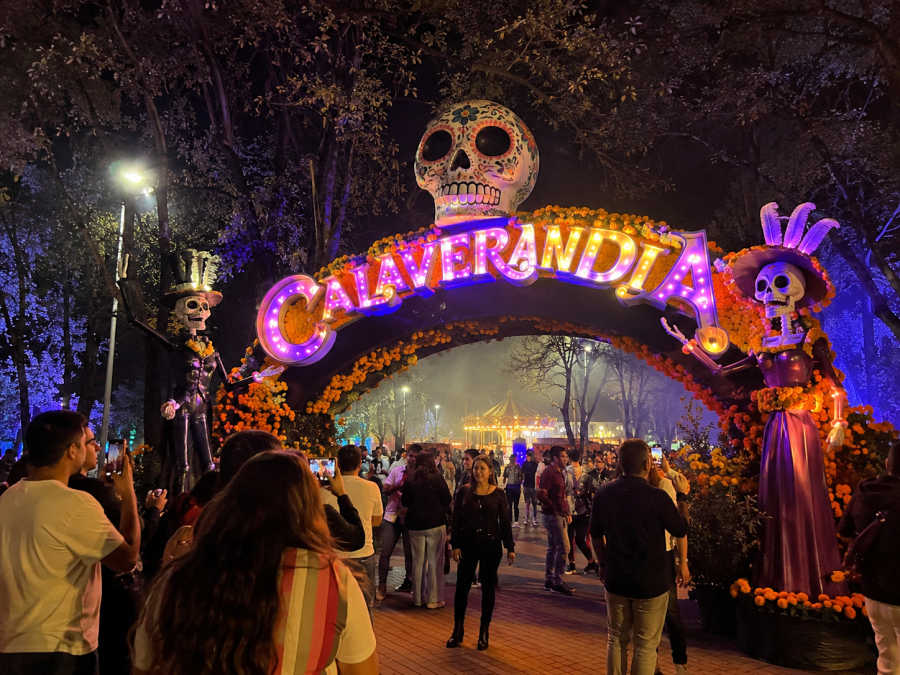
Many first-time visitors associate Day of the Dead almost exclusively with places such as Oaxaca or Michoacán.
Those destinations deserve their reputation, but Día de Muertos is celebrated throughout Mexico, and Guadalajara offers its own fascinating combination of tradition, contemporary culture and big-city creativity.
During this season, you may encounter altars in cultural institutions, plazas, restaurants, hotels and public spaces. Bakeries sell seasonal breads, flowers appear throughout markets, and artistic representations of La Catrina become almost impossible to avoid.
Guadalajara also gives travelers something particularly useful: variety.
You can spend the afternoon exploring the historic center, visit museums and markets, have dinner in one of the city’s excellent restaurants and then finish the evening immersed in an entirely different version of Día de Muertos at Calaverandia.
It makes the tradition approachable for international visitors without pretending that a theme park is the same thing as a family or community observance.
Think of Calaverandia instead as Mexico’s Day of the Dead reimagined as immersive entertainment.
So, What Exactly Is Calaverandia?
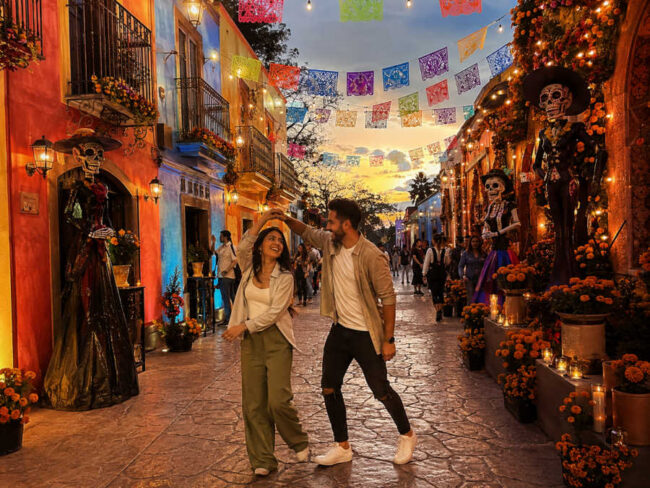
Imagine walking into a park after sunset and finding yourself surrounded by giant skulls, marigolds, candlelight, fantastical Mexican villages, elaborate Catrinas, glowing trees and music.
Now add theatrical performers.
Then water projections.
Then interactive attractions.
Then monumental altars.
Then thousands of people taking photographs.
That begins to describe Calaverandia.
The experience is designed as a journey through different environments rather than as one single show.
Visitors move through areas with different moods and themes, from colorful fantasy villages to darker representations of the underworld.
The 2026 program includes attractions such as ALMA, Taü, Gran Altar Canoil, Omitlán, Inframundo, Cementerio Tecnolite, La Plaza, El Pueblito, Fuente de Pelotas, Feria Limbo, artistic installations, interactive games, giant-scale decorations, costumed characters and numerous photo opportunities.
And because the entire experience takes place after sunset, the atmosphere becomes increasingly dramatic as the night progresses.
Start with ALMA
There are plenty of things to see at Calaverandia, but ALMA is one attraction you should plan around rather than accidentally discover.
It is one of the park’s major spectacle experiences and helps explain why Calaverandia has become so distinctive.
Instead of presenting Día de Muertos as a static cultural exhibition, ALMA uses contemporary show technology to create an emotional and visual performance.
Light, sound, water and storytelling come together in a large-scale nighttime production.
Even if you do not speak much Spanish, experiences like this often work surprisingly well for international visitors because much of the story is communicated visually.
Our suggestion?
When you arrive, check the evening’s performance schedule first.
Then plan your walk through the rest of the park around the major shows.
Otherwise, it is remarkably easy to spend 30 minutes taking photographs of giant skulls and suddenly realize the performance you wanted to see has already started.
Omitlán: One of the Best Places for Photos
Some places simply seem designed for photographs.
Omitlán is one of them.
It takes the visual language of a traditional Mexican town and pushes it into fantasy.
Expect color.
Expect architectural details.
Expect skeletons.
Expect flowers.
Expect several people in your group to say, “Wait, take one more.”
The appeal of this area is that it feels playful rather than solemn.
For foreign visitors who may have imagined Día de Muertos as something dark or mournful, places like Omitlán illustrate one of the most surprising characteristics of the tradition:
Mexican remembrance can be joyful.
People tell stories.
Families share food.
Music is played.
Favorite drinks are placed on altars.
The personalities of those who have died are remembered rather than erased.
That joy is reflected throughout Calaverandia.
Meet the Inframundo
Then things become darker.
Welcome to the Inframundo, or underworld.
Mexican ideas about death extend far beyond the imagery most international visitors recognize from modern Día de Muertos celebrations.
Long before the arrival of Europeans, Indigenous civilizations in Mexico developed complex beliefs about death, the afterlife and journeys into other worlds.
Calaverandia draws from this larger cultural imagination and turns it into an immersive environment.
The Inframundo changes the pace of the visit.
The bright colors of other areas give way to something more mysterious. The mood becomes theatrical and exploratory.
It is less about posing for a photograph and more about moving through an experience.
For visitors interested in Mexican culture, it can also be a good reminder that Day of the Dead is not one single tradition frozen in time.
It is the product of centuries of cultural evolution.
The Gran Altar: The Emotional Side of the Celebration
If you really want to understand Día de Muertos, you need to understand the ofrenda, or altar.
For Mexican families, an altar is not simply seasonal decoration.
It can be an intensely personal space.
Photographs identify those being remembered. Candles illuminate the way. Marigolds provide color and symbolism. Favorite foods, drinks or objects may be included because they say something about the person who died.
Calaverandia enlarges this concept into the Gran Altar Canoil, one of the park’s major experiences and one of the attractions included in the general admission program for 2026.
It is here that the park moves beyond spectacle.
Behind all the colorful skulls and theatrical lighting is a simple human idea:
Someone we love may no longer be here, but that does not mean we have stopped telling their story.
You do not need to be Mexican to understand that.
Take a Walk Through the Cemetery
A cemetery may sound like an unlikely place for family entertainment.
In Mexico during Día de Muertos, however, cemeteries can be places of flowers, candles, stories and memory.
The Cementerio Tecnolite translates some of that atmosphere into an interactive environment within Calaverandia.
It is not meant to replicate a real cemetery ceremony.
Instead, it uses tombs, theatrical details, flowers, lighting and storytelling to explore the visual language surrounding remembrance.
For first-time international visitors, this can help explain why skull imagery in Mexico does not always have the same meaning it may carry elsewhere.
The skull can be humorous.
Elegant.
Artistic.
Satirical.
Nostalgic.
Sometimes all at once.
Look for La Plaza and El Pueblito
One of the pleasures of Calaverandia is that you do not have to spend the entire evening rushing from one headline attraction to another.
La Plaza and El Pueblito are part of the general experience and contribute to the feeling that you are wandering through a fantastical version of Mexico rather than simply visiting individual rides or shows.
These are the places to slow down.
Look at the decorations.
Watch the characters.
Listen to the music.
Buy something to eat.
Take photographs while there is still a little blue in the evening sky.
In fact, if photography matters to you, arriving early offers a major advantage.
The transition from golden hour to blue hour to full nighttime illumination can give you three completely different versions of the same park.
Calaverandia Is Surprisingly Good for Couples
At first glance, a theme park covered in skeletons may not sound particularly romantic.
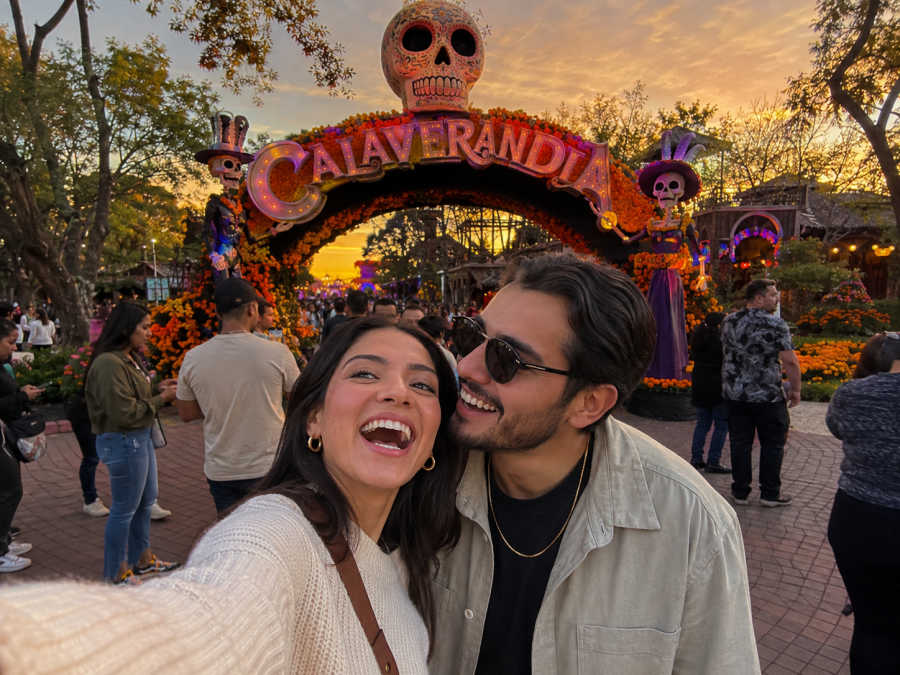
Then you arrive around sunset.
The sky turns gold behind the trees.
Strings of lights begin glowing.
Marigolds surround the walkways.
Music drifts across the park.
And suddenly you realize that Calaverandia is actually a very good date night.
Couples can wander through Omitlán, take photographs beneath the illuminated decorations, watch ALMA together and stop for food or drinks later in the evening.
The park also works well for groups of friends and multi-generational families.
The trick is not to approach the evening as though everyone must enjoy exactly the same attraction.
Some people will love the shows.
Some will love the cultural symbolism.
Some will spend the evening eating.
Some will leave with enough photographs to document the entire experience minute by minute.
There is room for all of them.
General Admission vs. Comfort Pass
Calaverandia offers different ticket experiences.
The General Admission ticket includes access to the principal attractions and environments, including ALMA, Taü, Gran Altar Canoil, Omitlán, Inframundo, Cementerio Tecnolite, La Plaza, El Pueblito, Feria Limbo, interactive games, artistic installations, characters and photo areas.
The Comfort Pass includes the general attractions plus additional benefits such as:
- Access to the Comfort Zone
- La Gran Resbaladilla
- Las Trajineras
- Preferential seating at performances, subject to availability
The Comfort Zone is described as a relaxing area among illuminated trees overlooking the lake, where visitors can enjoy Mexican food, beverages and cocktails.
Whether the upgrade makes sense depends on your travel style.
If your priority is simply seeing the main attractions, general admission covers a great deal.
If you value additional comfort, premium areas and some extras, the Comfort Pass may be more appealing.
How Long Do You Need?
Do not make the mistake of assuming you will be finished in an hour or two.
The recommended stay is approximately four hours, and arriving early is encouraged so visitors have enough time to experience the major attractions.
For most international travelers, we would suggest treating Calaverandia as your main evening activity.
Do not book a 9:30 p.m. dinner somewhere across town and expect to “quickly see” the park beforehand.
You will probably end up choosing between dinner and the giant skull.
The giant skull may win.
Calaverandia 2026 Opening Hours
For the 2026 season, the general operating schedule provided for tourism groups is:
Tuesday, Wednesday, Thursday and Sunday
7:00 p.m. – 12:00 a.m.
Friday and Saturday
7:00 p.m. – 1:00 a.m.
The park is located at Parque Ávila Camacho in Guadalajara, Jalisco.
Schedules and attraction availability can change, so travelers should verify their chosen date before attending.
What Should You Wear?
This is an easy one.
Wear comfortable shoes.
You will walk.
And walk.
And stop for photographs.
And then walk considerably farther than you expected.
A jacket is also a good idea for late October and early November evenings in Guadalajara.
The park itself recommends comfortable clothing, good walking shoes and a jacket.
You do not need formal clothing.
You do need footwear that will still be your friend four hours later.
Can You Bring a Camera?
There is one detail content creators should know.
According to the visitor information supplied for 2026, professional photography equipment is not permitted for ordinary visitors; personal photography is allowed with mobile phones. Professional or commercial photography requires separate arrangements.
For most travelers, that is not a problem.
Modern phones handle the park’s dramatic lighting surprisingly well.
Charge your battery before arriving.
If you love taking photos, bring a portable charger.
Calaverandia is not kind to a phone sitting at 17%.
Food, Payments and Practical Details
Credit and debit cards are accepted.
The park also provides a cashless option for visitors who arrive with cash, allowing funds to be loaded onto a ticket or card used for purchases inside the event.
Outside food and drinks are not permitted.
The visitor rules also prohibit items including pets, drones, glass containers, aerosols, flammable substances and sharp objects. Strollers, wheelchairs, crutches and umbrellas are permitted.
There is also a first-aid station available inside the park.
Is Calaverandia Authentic?
This is a reasonable question.
Calaverandia is a commercial entertainment experience.
It is not the same thing as being invited into a Mexican family’s home to see an altar dedicated to grandparents.
It is not the same thing as visiting a cemetery where generations of a family gather around the graves of relatives.
And it does not need to pretend otherwise.
What Calaverandia does very effectively is use entertainment to introduce visitors to the visual language, emotions and imagination surrounding Día de Muertos.
For travelers, the best approach is to experience both worlds.
Visit an altar.
Learn what the objects on it mean.
Try pan de muerto.
Visit a market filled with cempasúchil.
Then go to Calaverandia and watch those same cultural symbols explode into theatrical scale.
Together, the experiences provide a much richer understanding of the season.
Make It Part of a Guadalajara Día de Muertos Trip
Calaverandia should not necessarily be your only Día de Muertos experience in Guadalajara.
Make it part of a broader visit.
Spend time exploring Guadalajara’s historic center.
Walk through its plazas.
Visit local markets.
Experience Tlaquepaque.
Try regional food.
Look for public altars and seasonal cultural activities.
And then, one evening, arrive at Parque Ávila Camacho before the sky becomes completely dark.
Watch the final golden light disappear between the trees.
See the first candles begin to glow.
Listen as the park becomes louder.
Then walk beneath the skeletons and flowers into Calaverandia.
For international visitors, there may be no better reminder that Mexican culture does something remarkable with a subject much of the world tries not to discuss.
Here, death becomes art.
Memory becomes celebration.
And absence is answered with flowers, food, music and stories.
That is why Día de Muertos remains one of Mexico’s most extraordinary traditions.
And in Guadalajara, Calaverandia 2026 offers one spectacular way to step inside that world.